Excellence in Eco-Friendly Charcoal
Leading The Way In Sustainable Charcoal Production In South Africa
At Royal Charcoal, We take pride in transforming nature’s resources into Premium-Quality Charcoal through a process that is both Efficient and Environmentally Responsible. Our Charcoal begins its journey with Sustainably Sourced Hardwood, carefully harvested to Protect Ecosystems. Through Controlled Carbonization, the wood is slowly heated in Low-Oxygen Environments, converting it into High-Density Charcoal with exceptional Burning Qualities. Finally, our Advanced Processing and Grading Systems ensure that every piece meets International Standards for Consistency, Cleanliness, and Performance — ready to deliver the best Cooking and Heating experience for our customers.


Our Services
Leading the way in Sustainable Charcoal Production & Quality while prioritizing Environmental Responsibility.
Sustainable Practices
We implement eco-friendly methods to produce high-quality charcoal with minimal environmental impact.


Quality Assurance
Our products meet the highest standards, ensuring excellence in every batch of charcoal produced.
Dedicated to reducing our carbon footprint while providing premium charcoal for various applications.
Environmental Commitment


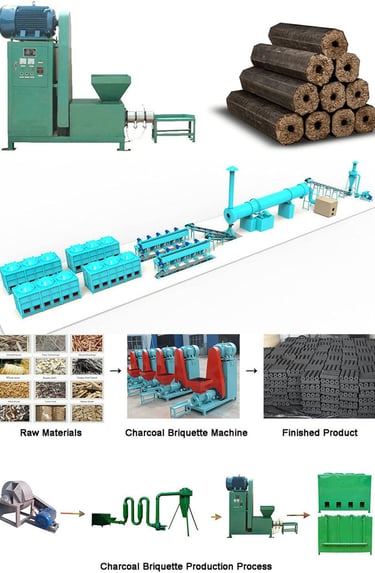
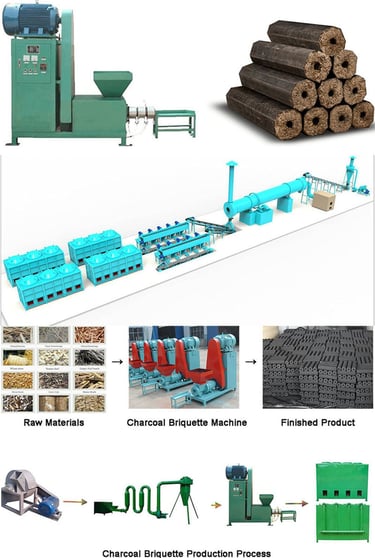
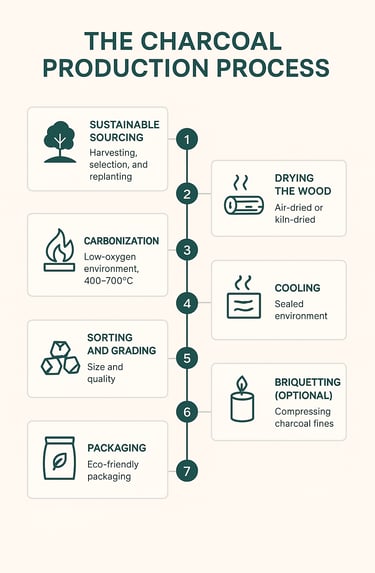
Processes Involved To Deliver The Best Quality Charcoal
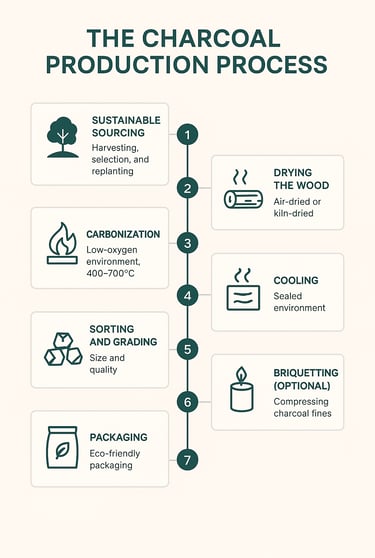
1. Sustainable Sourcing
Harvesting: Wood is sourced from sustainably managed forests or plantations.
Selection: Only hardwood species with the right density and moisture content are chosen for optimal charcoal quality.
Replanting: Many producers, like Royal Charcoal, support reforestation programs to replace harvested trees.
2. Drying the Wood
Freshly cut wood often has high moisture content.
It is air-dried or kiln-dried to reduce moisture, ensuring efficient carbonization and better-quality charcoal.
3. Carbonization
The Core Process: This is where wood is heated in a low-oxygen environment to remove water and volatile compounds, leaving nearly pure carbon.
Traditional Kilns or Modern Retorts:
Earth kilns are simple, traditional methods.
Retort kilns and modern reactors are more efficient, eco-friendly, and produce higher-quality charcoal.
Temperatures typically range between 400–700°C.
4. Cooling
After carbonization, the charcoal must cool in a sealed environment to prevent it from catching fire when exposed to oxygen.
5. Sorting and Grading
Charcoal pieces are sorted based on size and quality.
Fines (smaller particles) may be processed into briquettes.
6. Briquetting (Optional)
Charcoal fines are mixed with natural binders and compressed into charcoal briquettes for consistent size and shape.
7. Packaging
Final products are bagged in eco-friendly packaging for distribution to local and international markets.
Join Our Eco-Friendly Journey
Stay updated on sustainable charcoal innovations.


Sustainability
Leading environmentally conscious charcoal production.
GET IN TOUCH
Have A Question?
info@royal-charcoal.co.za
export@royal-charcoal.co.za
+27 63 7608 582
© 2025. All rights reserved.